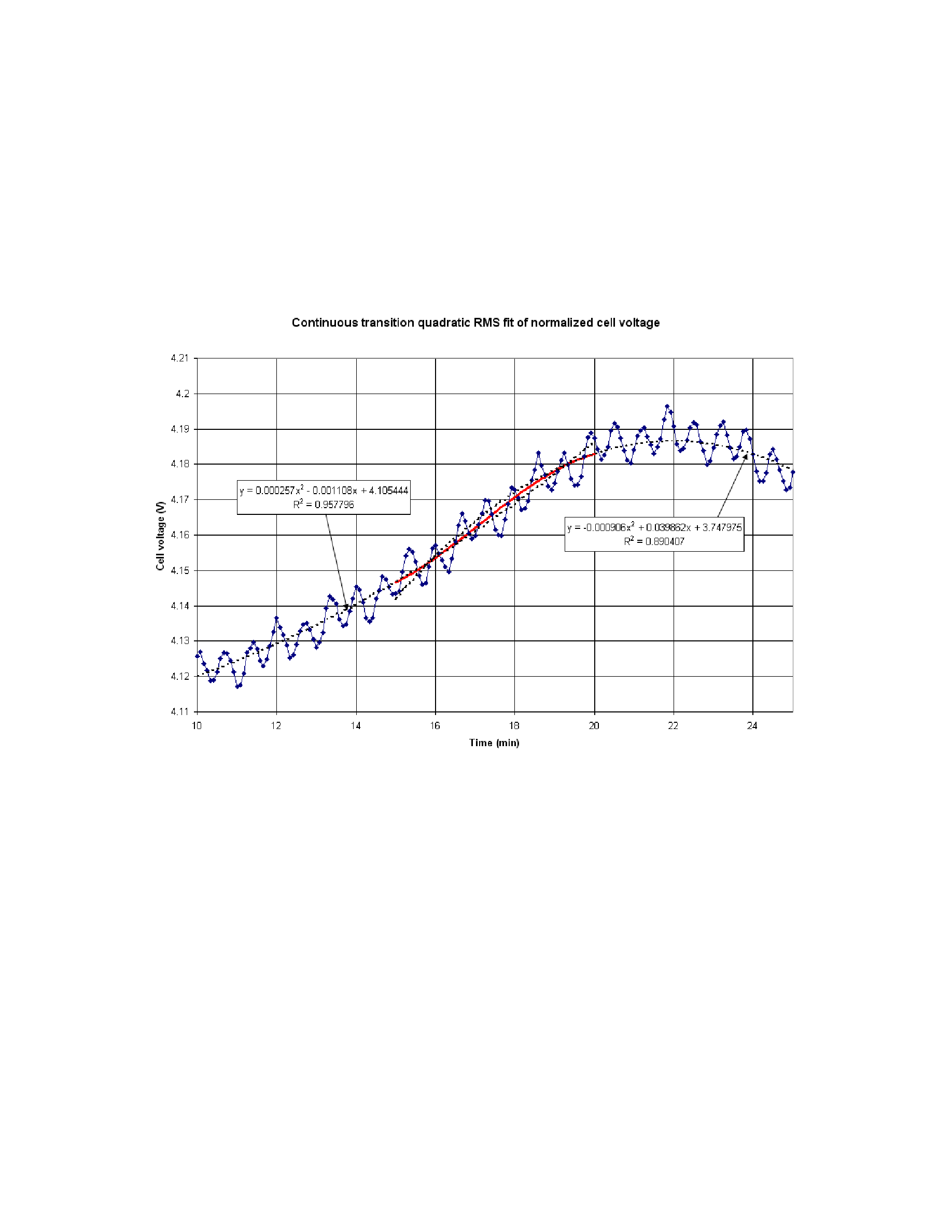
to produce a single continuous curve by doing some interpolation. For example, the red
curve in Figure 11 is produced by interpolating between the two overlapping fitted
curves in the 15 to 20 minutes time segment. The interpolation is done is such a way that
even the first derivative of the curve is continuous between time segments.
Figure 11: Continuous transition quadratic RMS fit of normalized cell voltage
Repeating this procedure from time segment to time segment produced the red
improving the slope estimation at the end of the last available segment which is the
current time when the information is required to take control actions as part of the cell
control logic.
Yet, at least this red curve in Figure 12 can now be compared to the equivalent of
algorithm.